


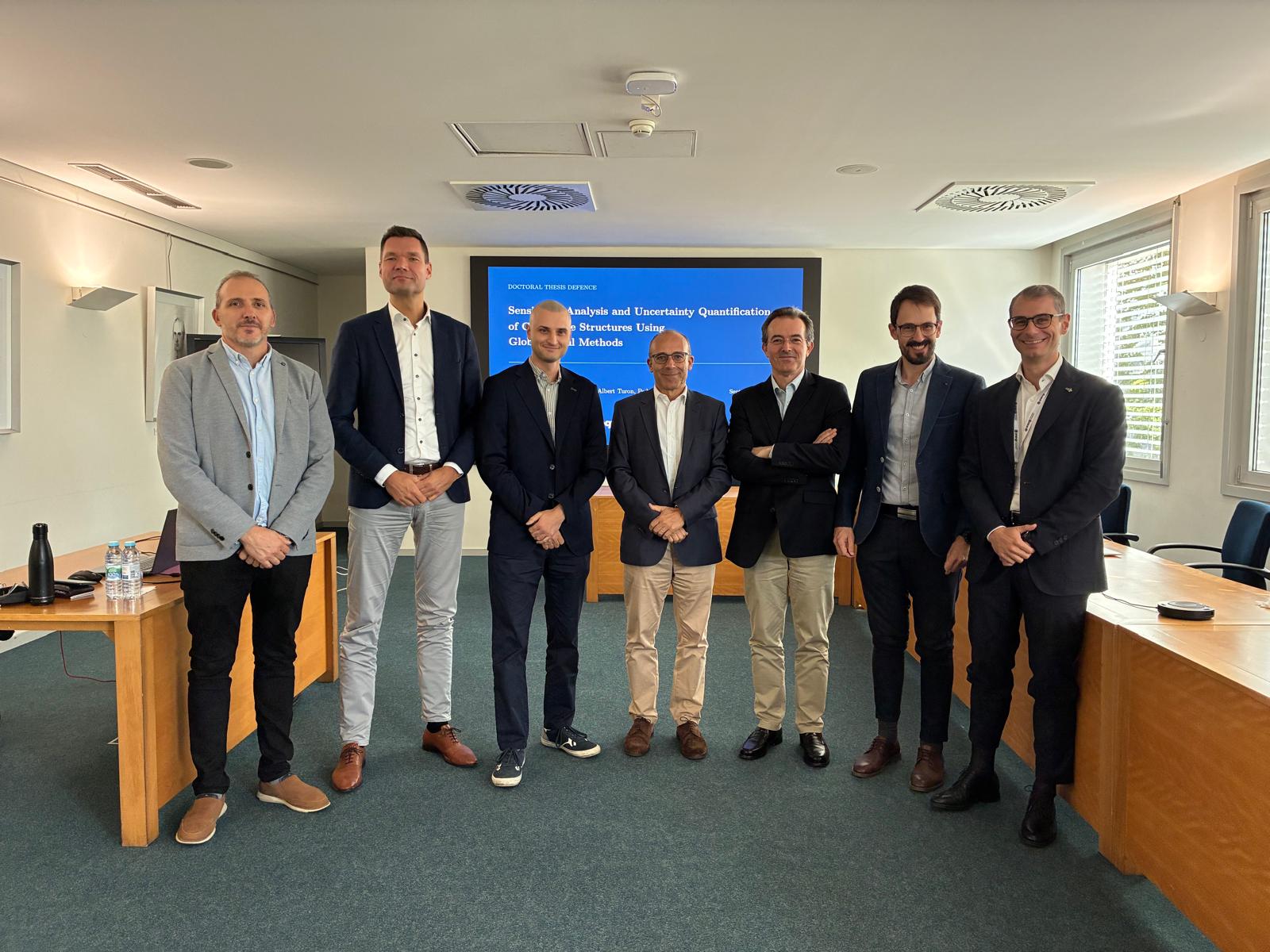
07 Oct Paolo Minigher defends his PhD thesis on sensitivity analysis and uncertainty quantification of composite structures
On 28 September 2026, Paolo Minigher successfully defended his doctoral thesis entitled “Sensitivity Analysis and Uncertainty Quantification of Composite Structures Using Global/Local Methods” at the Faculty of Engineering of the University of Porto (FEUP), Portugal, obtaining the degree of Doctor.
The thesis, developed within the field of computational mechanics and advanced composite materials, focuses on the development of new methodologies to improve the analysis and prediction of the behaviour of composite structures under uncertainty conditions, with particular relevance to aerospace applications.
Composite structures are widely used in high-performance applications due to their excellent mechanical properties and lightweight characteristics. However, their complex behaviour, together with variability in material properties and manufacturing processes, represents a significant challenge for accurate numerical prediction. In this context, Paolo Minigher’s research has contributed to the development of more efficient computational approaches for sensitivity analysis and uncertainty quantification, enabling more reliable structural simulations while reducing computational costs.
The work addresses complex nonlinear phenomena, including damage propagation, buckling, post-buckling behaviour and contact, through the combination of global structural models with detailed local analyses. Among the main contributions of the thesis are the development of efficient sensitivity analysis methodologies for nonlinear structural problems, a restart-based approach to evaluate structural responses near limit points, the integration of uncertainty propagation strategies within global/local simulations, and an adaptive remeshing methodology capable of following damage evolution while maintaining sensitivity information.
The proposed approaches were assessed through different representative composite structures, including open-hole laminates, bolted joints, shell structures and stiffened composite panels.
The doctoral thesis was supervised by Prof. Pedro P. Camanho and Prof. Albertino Arteiro, from the University of Porto, and Prof. Albert Turon, from the University of Girona.
The PhD defense committee was composed of Prof. Francisco Manuel Andrade Pires (University of Porto), who acted as Chair, Prof. Joaquim R. R. A. Martins (University of Michigan), Prof. Alfonso Pagani (Politecnico di Torino), Prof. Esben Lindgaard (Aalborg University), and Prof. Albertino Arteiro (University of Porto).
This research was carried out within the framework of the IRT Saint Exupéry TRUST project (Towards cRedible simUlation of compoSite sTructures), coordinated by Ludovic Barriere from IRT Saint Exupéry. The project was supported by the French Government through the Future Investment Program and involved the collaboration of Airbus, Airbus Atlantic, Ariane Group, Hexcel, Eikosim, INEGI, INSA Toulouse and the University of Girona.
The results obtained during the doctoral research have been disseminated through several scientific publications, including articles in the journals International Journal of Solids and Structures and Computers & Structures, as well as additional contributions currently available as preprints.
The AMADE research group congratulates Dr. Paolo Minigher on this achievement and wishes him every success in his future scientific and professional career.