
19 Nov New publication in Composites Part A: Understanding stress relaxation mechanisms to improve self-healing vitrimer-based composites
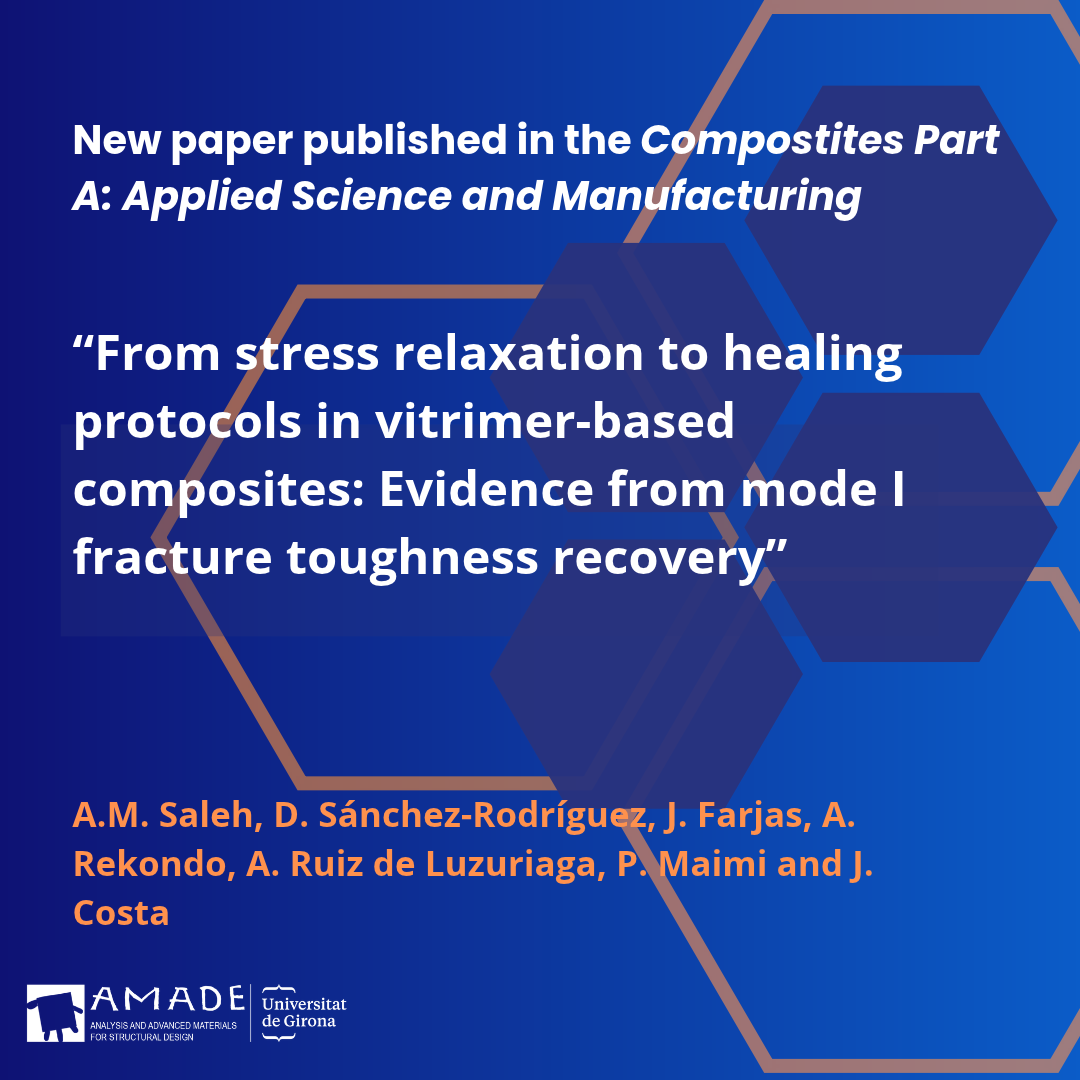
A new study by researchers from AMADE, in collaboration with CIDETEC, has been published in the international peer-reviewed journal Composites Part A: Applied Science and Manufacturing. The article, entitled “From stress relaxation to healing protocols in vitrimer-based composites: Evidence from mode I fracture toughness recovery”, provides new insights into the mechanisms governing self-healing in advanced composite materials.
The paper, authored by A. M. Saleh, D. Sánchez-Rodríguez, J. Farjas, A. Rekondo, A. Ruiz de Luzuriaga, P. Maimí and J. Costa, investigates the relationship between stress relaxation behaviour and the recovery of mechanical performance in vitrimer-based fibre-reinforced composites.
Vitrimers are a new generation of polymer materials that combine the mechanical performance of thermosets with the ability to undergo network rearrangement through dynamic bond exchange reactions. This unique behaviour enables the possibility of repairing damage and recovering mechanical properties, offering promising opportunities for more durable and sustainable composite structures.
Measuring how well these materials heal is not straightforward. Conventional interlaminar delamination tests mix the healing of the matrix with fibre-related effects, such as crack migration through the fibre architecture and fibre bridging, while bonded joints with aluminium adherends add an interface that does not take part in bond exchange. The study therefore introduces secondary-bonded double cantilever beam (DCB) joints in which both the adhesive layer and the matrix of the carbon fibre adherends are the same vitrimer, so that the measured recovery reflects the healing of the vitrimer itself.
In this study, the researchers analyse the role of the stress relaxation time as the intrinsic timescale of the healing process, since both stress relaxation and self-healing are governed by the same bond exchange reactions. Through mode I fracture toughness recovery experiments at healing temperatures between 175 °C and 225 °C, the work demonstrates that healing efficiency can be directly related to the intrinsic relaxation behaviour of the material, providing a rational approach for defining temperature and time conditions for self-healing treatments.
Between 200 °C and 220 °C, the healing efficiencies collapse onto a single master curve when the healing time is normalised by the stress relaxation time, recovering up to 88% of the original fracture toughness. For example, healing for 30 minutes at 200 °C or for about 4.5 minutes at 220 °C gives the same recovery, as both correspond to 90 times the relaxation time.
The results establish a connection between rheological characterisation and practical healing protocols, contributing to a better understanding of how vitrimer-based composites can be designed for structural applications where durability, repairability and extended service life are key requirements.
This research represents a significant step towards the development of next-generation repairable composite materials with improved sustainability and long-term performance.
Publication
Title: From stress relaxation to healing protocols in vitrimer-based composites: Evidence from mode I fracture toughness recovery
Authors: A. M. Saleh, D. Sánchez-Rodríguez, J. Farjas, A. Rekondo, A. Ruiz de Luzuriaga, P. Maimí & J. Costa
Read the full article:
https://doi.org/10.1016/j.compositesa.2026.110426